 Chessabellés
Giving back · Not for profit
Chess for senior women
Chessabellés is setting up not-for-profit chess lessons and programs for older women in nursing homes, retirement villages and community centres: a chance to learn the game, or come back to it, and play with their peers. It’s our way of giving back: good company, a friendly challenge, and a workout for the mind.
Bring chess to your community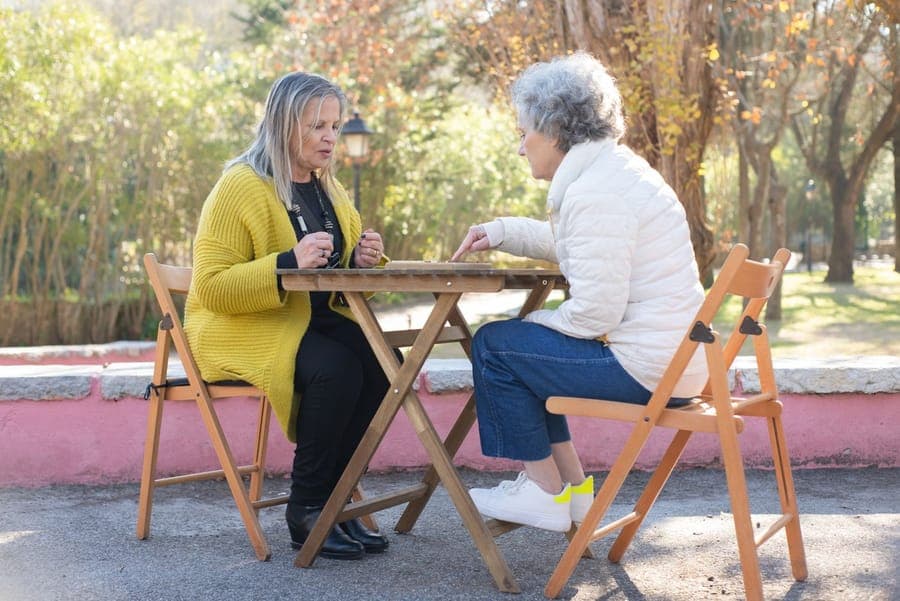
What it looks like
- Not-for-profit sessions in nursing homes, retirement villages, libraries and community centres
- For complete beginners as well as women who played years ago and want to come back to it
- A relaxed pace, seated play and large, easy-to-read pieces and boards
- Friendly games against peers, puzzles to solve together, and a small tournament now and then
Good for the brain
Chess asks a lot of the brain: planning ahead, remembering patterns, concentrating, and adapting when the position changes. Large, long-running studies have found that older people who regularly play chess and other board games tend to have a lower risk of dementia, including Alzheimer’s disease, and keep their thinking skills better as they age. Playing with others matters too: loneliness and social isolation in later life are themselves risk factors for dementia.
74%
lower risk of dementia among people over 75 who often played board games, in a study of 469 people followed for about five years.
Verghese et al., New England Journal of Medicine, 2003 (opens in a new tab)15%
lower risk of dementia among regular board game players, in 3,675 older people in France followed for 20 years.
Dartigues et al., BMJ Open, 2013 (opens in a new tab)9–11%
lower risk of dementia among 10,318 Australians aged 70 and over who regularly did mentally active pastimes such as games, cards, chess, puzzles and crosswords, or literacy activities like classes and writing.
Jin et al. (ASPREE, Monash University), JAMA Network Open, 2023 (opens in a new tab)1,091
people followed from age 11 to 79. Those who played more board games, cards and chess in their 70s had less decline in their thinking skills from 70 to 79.
Altschul & Deary, Journals of Gerontology, 2019 (opens in a new tab)21
studies reviewed on chess and dementia. The review found chess may help prevention in people without dementia, with little evidence yet for people already diagnosed.
Lillo-Crespo et al., Int. Journal of Environmental Research and Public Health, 2019 (opens in a new tab)45%
of dementia cases could be prevented or delayed by tackling 14 risk factors across life, according to the Lancet Commission. Social isolation in later life is one of them.
Livingston et al., The Lancet, 2024 (opens in a new tab)
What the research does and doesn’t say
These studies show a strong link between playing games like chess and a lower risk of dementia, but they can’t prove the games are the cause, and chess isn’t a treatment for someone who already has dementia. Keeping the mind challenged, and staying connected with other people, are among the best-supported ways to look after the brain as we age, and chess with friends does both.
For aged care homes and community groups
If you run a nursing home, retirement village, seniors’ club or library in Melbourne and would like regular chess sessions for the women there, get in touch and we’ll talk about what would work best.